What's at the National Archive?

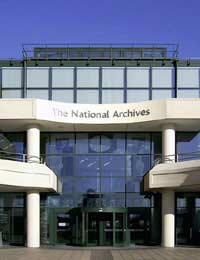
Sooner or later, anyone looking into family history in Britain is going to need the National Archives (and Scotland and Ireland both have their National Archives, too). Located in Kew, outside London, it’s the repository for so many records that are useful in genealogy.
As time progresses, more and more of these records have come online, currently more than a billion of them, although that’s only a small percentage of what’s actually held at the Archives. From the Domesday Book onwards, it’s a wealth of information for every kind of historian.
History
The National Archives is a relatively new institution, one that represents a consolidation of four agencies, the Royal Commission on Historical Manuscripts, Her Majesty’s Stationery Office, the Office of Public Sector Information and the Public Records Office. During the course of the years 2003-2006 these came together to form the National Archives. It’s currently under the Ministry of Justice.Records
There are records of all kinds that are held by the National Archives. Many relate to government and armed forces business or to the central courts. These are all worthwhile, and certainly excellent for historians, but of limited appeal to genealogists.For family historians the National Archives is nonetheless an Aladdin’s cave of treasures. There are census records, dating up to 1911 (censuses can only be released after 100 years), military records from the 17th century up to 1920, naturalisation records and ship’s passenger lists running from 1878 to 1960, both for ships arriving and leaving Britain, records of service for several organisations, including the Metropolitan Police, and several centuries of wills from the Prerogative Court of Canterbury. Note that they don’t hold birth, marriage and death records.
Many of the records are available online, although obtaining copies does involve a fee, as the National Archives works with partners. The costs aren’t prohibitive, and are much cheaper than a trip to the Archives for those not close to London and only in need of certain things.
Visiting
From Tuesday to Saturday the Archives open at 9am, and close at 5pm, except for Tuesday and Thursday when it remains open until 7 pm. If you want to view original documents, you’ll need a reader’s ticket; to obtain one bring two forms of identification and be able to prove your address. For using microfilm and microfiche this isn’t necessary.Only pencils (no erasers) are allowed in the reading rooms. You can use a digital camera, but with the flash off, and both laptops and notepads are fine. You will have to pay for copies of documents, so you’ll need to bring money or use the ATM on site. The more information you have about what you need by the time you arrive, the better things will be. Finding the records you desire will be quicker and you’ll be able to obtain everything you need in one visit.
If you have a reader’s ticket you can order up to six documents that will be ready for your visit to speed things up. This can be done online or on the phone. Most of the reading will be done in the open reading room. If you’re examining original documents, this will have to be in the document reading room (there’s another document reading room on the second floor).
For those who have to travel some distance, it’s worth building up your queries so you can spend a full day at the Archives resolving them.
- Genealogy and a Criminal Past
- How to Deal With Conflicting Dates in Genealogy.
- Tracing the Female Line in your Ancestry
- How to Use Obituaries for Study
- Taking a Genealogy Course
- Using the International Genealogical Index
- Using Local Libraries as Sources
- How Do You Know When You've Really Hit a Dead End?
- The Increase in Online Genealogical Resources
- Researching British Genealogy from Abroad
- The Importance of the 1911 Census
- Do You Need a Professional Genealogist?
- Latin In Church and Legal Records
- The Family Bible In Genealogy
- Genealogy And Military Records
- How To Find And Use Medieval Genealogy Information
- The Importance of the Protestation in Genealogy
- Checking Taxation Records for Family History Research
- Sharing The Results Of Your Genealogy Research
- Using Criminal Records For Family History Research
- How Museum Collections Can Help You In Genealogy
- Poor Law Records and Tracing Your Family Tree
- Surname Variations When Tracing Your Family Tree
- Tracing Ancestors Transported to the Colonies as Criminals
- Tracing Family History On The Female Side
- Using Geographical Maps to Trace Family History
- Using The Internet to Trace Your Ancestors
- Utilising Local History To Research Your Family Tree
- Genealogy and Medical Records

Re: Using Criminal Records For Family History Research
Trying to find dads past history with arrests just out of interest as hes recently passed away and…
Re: Using Criminal Records For Family History Research
Hi all i wanted to find out about my dad's past and nobody seems to know much about it or what he did.…
Re: Maiden Names in Genealogy
Looking for my fathers mother maiden name
Re: Genealogy and a Criminal Past
I am trying to find out about my father crime in 1992 or 1993 my father as pass away 1998 and I would like to find out why he got…
Re: Using Criminal Records For Family History Research
I am trying to find my biological father's police criminal record as I was abused as a child but have…
Re: Cremation Records and Tracing Your Family History
I am trying to find out where has my friends aunt Adelinda Diaz McMullen was cremated and who was her…
Re: Cremation Records and Tracing Your Family History
CAN SOMEONE PLEASE HELP ME WITH TRYING TO FIND OUT WHERE MY FATHER WAS CREMATED/BURIED IN KENT UK. I…
Re: What If You Have Asian Roots?
Ancestor Edward Albert Wells was born in Trichinopoly on 8 May 1833 to his father George Wells of the 54th Regiment at Foot and…
Re: How to Use Church Marriage Records to Trace Your Ancestors
It is still legal for first cousins to marry.
Re: Cremation Records and Tracing Your Family History
My sister finance was cremation and she stayed up by his bedside at Augusta university for days on out…