Surnames And Places

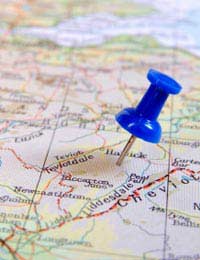
Surnames come in many different ways. Some are from professions, others indicate relationships (Johnson, for instance would at some distant point have been the son of John). Others derive from places, and that particular Meaning Of Surnames can be very useful in Genealogy, or at least if often can.
If the place name is very specific, especially if it’s a village, rather than a town, it can give a particular point of origin for your family, or at the very least offer an indication. Make no mistake, those obscure village names are still in use as surnames, many centuries after the fact – the problem lies in connecting the dots between now and then.
What Surnames Involving Places Tell Us
Sometimes, as with the names of places, surnames can tell us a great deal. More often, though, they can only provide a general level of information. Let’s say, for instance, that your last name is French or Moore. From that, genealogy can conclude that at one point you had foreign ancestors (Moore comes from Moroccan, as do its many derivatives like, believe it or not, Morris, which started out as Moorish).That’s hardly exact, is it? But it’s a clue. Some names, though, are even more nebulous, like Hill, Dale, Wood, Burns (streams) and so on – place names of a sort, but taken from geographical features.
You will sometimes find town names or their derivations as surnames – Newport, York, Sheffield, and so on – all of which would indicate that many generations ago your ancestor was born, or at least spent a long time, in that place. It’s a useful clue, but more tantalising that promising. The meaning of that surname tells you something, the trick is find out exactly what, and when it’s relevant.
By around 1400, surnames had become fairly fixed, and 100 years later were definitely so; even if someone named Cooper no longer made barrels, the name stayed in the family unless it was changed deliberately (which did happen – with unfortunate regularly for genealogy). Even a name like Thorp or Thorpe harks way back, as it means village or town (place names in the North of England ending in -by are a legacy of the Vikings, meaning farm).
Back in the Middles Ages, many serfs were essentially the property of those who owned the land, and some took those owners’ names as their own (much as slaves did in the West Indies and the US). Having a name that seems to derive from a place could also mean that the name actually comes from the owner – whose estates would be vast.

Re: Using Criminal Records For Family History Research
Hi all i wanted to find out about my dad's past and nobody seems to know much about it or what he did.…
Re: Maiden Names in Genealogy
Looking for my fathers mother maiden name
Re: Genealogy and a Criminal Past
I am trying to find out about my father crime in 1992 or 1993 my father as pass away 1998 and I would like to find out why he got…
Re: Using Criminal Records For Family History Research
I am trying to find my biological father's police criminal record as I was abused as a child but have…
Re: Cremation Records and Tracing Your Family History
I am trying to find out where has my friends aunt Adelinda Diaz McMullen was cremated and who was her…
Re: Cremation Records and Tracing Your Family History
CAN SOMEONE PLEASE HELP ME WITH TRYING TO FIND OUT WHERE MY FATHER WAS CREMATED/BURIED IN KENT UK. I…
Re: What If You Have Asian Roots?
Ancestor Edward Albert Wells was born in Trichinopoly on 8 May 1833 to his father George Wells of the 54th Regiment at Foot and…
Re: How to Use Church Marriage Records to Trace Your Ancestors
It is still legal for first cousins to marry.
Re: Cremation Records and Tracing Your Family History
My sister finance was cremation and she stayed up by his bedside at Augusta university for days on out…
Re: Cremation Records and Tracing Your Family History
I am trying to find out where my partners mother was cremated. Patricia Florence Bennett. Cremated…